
Assam Agriculture: Crops, Farming, Challenges and Future Opportunities
Contents
Introduction
Assam agriculture plays an important role in the economy, employment, and livelihood of the people of Assam. Located in northeastern India, Assam has fertile plains, abundant rainfall, rivers, and a favourable climate for growing a wide variety of agricultural crops. Agriculture supports millions of people directly or indirectly and contributes significantly to the state’s rural economy.
Farming in Assam includes rice cultivation, tea production, mustard farming, vegetable cultivation, fruit production, fisheries, and livestock rearing. Although the state has considerable agricultural potential, farmers face several challenges, including floods, soil erosion, limited access to modern technology, and difficulties in marketing their products. Developing a sustainable agricultural sector is essential for improving farmers’ incomes and strengthening Assam’s economy.
Importance of Agriculture in Assam
Agriculture is one of the major sources of livelihood in Assam, particularly in rural areas. Many families depend on farming for food, income, and employment. Agricultural activities also support other industries, including food processing, transportation, storage, and local trading.
The agricultural sector contributes to food security by producing rice, vegetables, pulses, fruits, and other essential products. It also provides raw materials for various industries and creates opportunities for small businesses.
Agriculture is closely connected with Assam’s culture and traditions. Festivals such as Bihu reflect the relationship between farming, seasonal changes, and rural life. Therefore, agricultural development is important not only for economic growth but also for preserving the state’s cultural heritage.
Major Agricultural Crops of Assam
1. Rice Cultivation
Rice is the most important food crop in Assam. The state’s climate, rainfall, and fertile alluvial soil support rice cultivation across many districts. Rice is a staple food for the majority of Assam’s population.
Farmers generally cultivate different varieties of rice according to the season, including autumn, winter, and summer rice. Winter rice, commonly known as Sali rice, is particularly important in many agricultural areas.
However, excessive rainfall, floods, pests, and irregular weather can affect rice production. Improved seeds, better irrigation, flood-resilient varieties, and scientific farming methods can help increase productivity.
2. Tea Production
Assam is internationally famous for its tea industry. Assam tea is known for its strong flavour, rich colour, and distinctive aroma. The tea industry contributes to employment, exports, tourism, and the state’s economy.
Large tea estates and small tea growers operate in different parts of Assam. Tea cultivation also supports workers involved in plucking, processing, packaging, and distribution.
Despite its importance, the tea sector faces challenges such as changing weather conditions, production costs, labour-related concerns, and fluctuating market prices. Sustainable cultivation and improved processing methods can help strengthen the industry.
3. Mustard and Other Oilseeds
Mustard is an important oilseed crop in Assam. Farmers cultivate it mainly during the winter season, and its seeds are used to produce cooking oil.
Other oilseeds and pulses also contribute to agricultural diversification. Expanding oilseed cultivation through improved varieties, suitable farming practices, and better market access could help farmers increase their income and reduce dependence on imported edible oils.
4. Vegetables and Fruits
Assam produces vegetables such as potatoes, tomatoes, cabbage, cauliflower, brinjal, and green leafy vegetables. Fruits such as bananas, pineapples, oranges, lemons, and jackfruit are also grown in different regions.
Vegetable and fruit cultivation can provide farmers with additional income opportunities. However, these products are often perishable and require suitable storage, transportation, and marketing facilities.
Developing cold storage, food processing units, and organised markets could reduce post-harvest losses and improve farmers’ earnings.
Major Challenges Facing Assam Agriculture
Floods and Soil Erosion
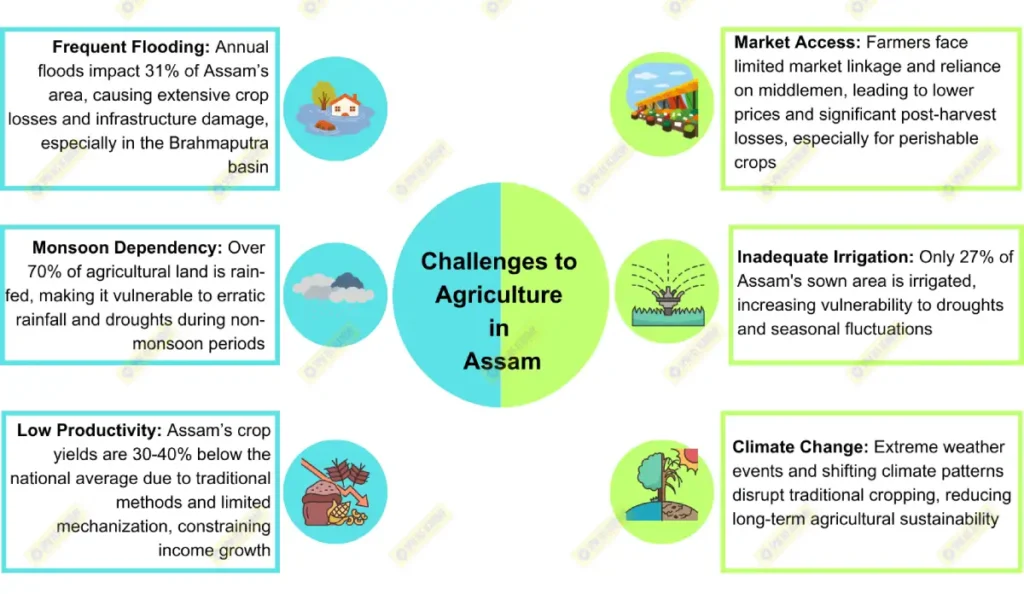
Floods are among the biggest challenges for agriculture in Assam. The Brahmaputra and its tributaries frequently affect agricultural land during the monsoon season. Flooding can destroy crops, damage roads, affect livestock, and disrupt the movement of agricultural products.
Riverbank erosion can also reduce the amount of cultivable land available to farming families. Better flood management, drainage systems, crop insurance, and flood-resilient agricultural practices are important for reducing these risks.
Traditional Farming Methods
Many farmers continue to depend on traditional farming techniques. Although these methods often reflect valuable local knowledge, limited access to modern equipment and scientific information can restrict productivity.
Training programmes, agricultural extension services, improved seeds, and affordable machinery can help farmers adopt more efficient methods.
Limited Irrigation Facilities
Although Assam receives substantial rainfall, the availability of water at the right time is not guaranteed everywhere. Some areas experience water shortages during particular growing seasons, while others face excessive waterlogging.
Small irrigation projects, rainwater harvesting, efficient water management, and suitable drainage systems can improve agricultural productivity.
Marketing and Storage Problems
Farmers sometimes struggle to obtain fair prices for their produce because of inadequate storage facilities, transportation difficulties, and dependence on intermediaries.
Strengthening farmer-producer organisations, improving rural roads, establishing storage centres, and expanding access to digital marketplaces could help farmers connect with buyers and reduce unnecessary losses.
Modern Technology and Sustainable Farming
Modern agricultural technology can play an important role in transforming Assam agriculture. Soil testing, improved seeds, mechanisation, weather forecasting, and digital advisory services can help farmers make informed decisions.
Organic farming and integrated farming systems also offer opportunities for sustainable development. Farmers can combine crop cultivation with livestock rearing, fisheries, and horticulture to diversify their income sources.
The use of compost, crop rotation, integrated pest management, and responsible water use can help maintain soil fertility and protect the environment.
Climate-smart agriculture is particularly important for Assam because farmers must adapt to floods, changing rainfall patterns, and other weather-related risks.
Government Support for Farmers
Government programmes can support agricultural development through financial assistance, crop insurance, irrigation projects, training, and access to improved agricultural inputs.
Schemes such as PM-KISAN, the Pradhan Mantri Fasal Bima Yojana, and the Pradhan Mantri Krishi Sinchayee Yojana have objectives related to farmer support, crop-risk protection, and irrigation development, subject to the eligibility conditions and implementation arrangements of each scheme.
The Assam government and agricultural institutions also contribute through farmer training, research, extension services, and support for agricultural infrastructure.
Farmers should consult official government portals and local agriculture offices to check current scheme guidelines, eligibility requirements, application deadlines, and available benefits.
Future Opportunities for Assam Agriculture
Assam has significant potential to develop its agricultural sector further. Food processing, improved rice varieties, horticulture, fisheries, beekeeping, organic farming, and small-scale agricultural enterprises can create new employment opportunities.
The state can also improve the value of its agricultural products through better packaging, branding, processing, and distribution. Local products may reach wider markets when quality standards and reliable supply chains are strengthened.
Agricultural education and entrepreneurship can encourage young people to explore opportunities in agribusiness, farm machinery services, digital agriculture, food processing, and agricultural marketing.
Investment in rural infrastructure, scientific research, climate-resilient farming, and farmer training will be important for achieving these goals.
Conclusion
Assam agriculture is a vital part of the state’s economy and rural society. Rice cultivation, tea production, vegetables, fruits, and oilseeds provide food, employment, and income for many families.
However, floods, soil erosion, limited infrastructure, and marketing difficulties continue to create challenges for farmers. Addressing these problems requires cooperation among farmers, government institutions, researchers, and agricultural businesses.
By adopting suitable modern technologies, improving market access, expanding irrigation and storage facilities, and promoting sustainable farming, Assam can strengthen its agricultural sector. A productive and resilient agricultural economy will help improve rural livelihoods, support food security, and contribute to the long-term development of Assam.
Focus Keyphrase: Assam Agriculture